I recently had the privilege of visiting the village of Meignanapuram in southern Tamil Nadu. I went to the CSI church there, St. Paul’s, and to the graves of John Thomas and his wife Mary, who lie at the church they gave their lives to. I was struck by the beauty of the building: a tall Gothic church, built of local stone, rising out of red sand and palmyra palms, with a spire you can see long before you reach the village.
I wanted to know how it came to be there. Who built it, and why here? Who were the people, Tamil and English, whose names are on its walls and whose names are not? What changed for the families of the district, and what did the missionaries actually preach to them? This page is what I found, with the sources laid out so that you can check every claim yourself.
— the author of thinkask.ai
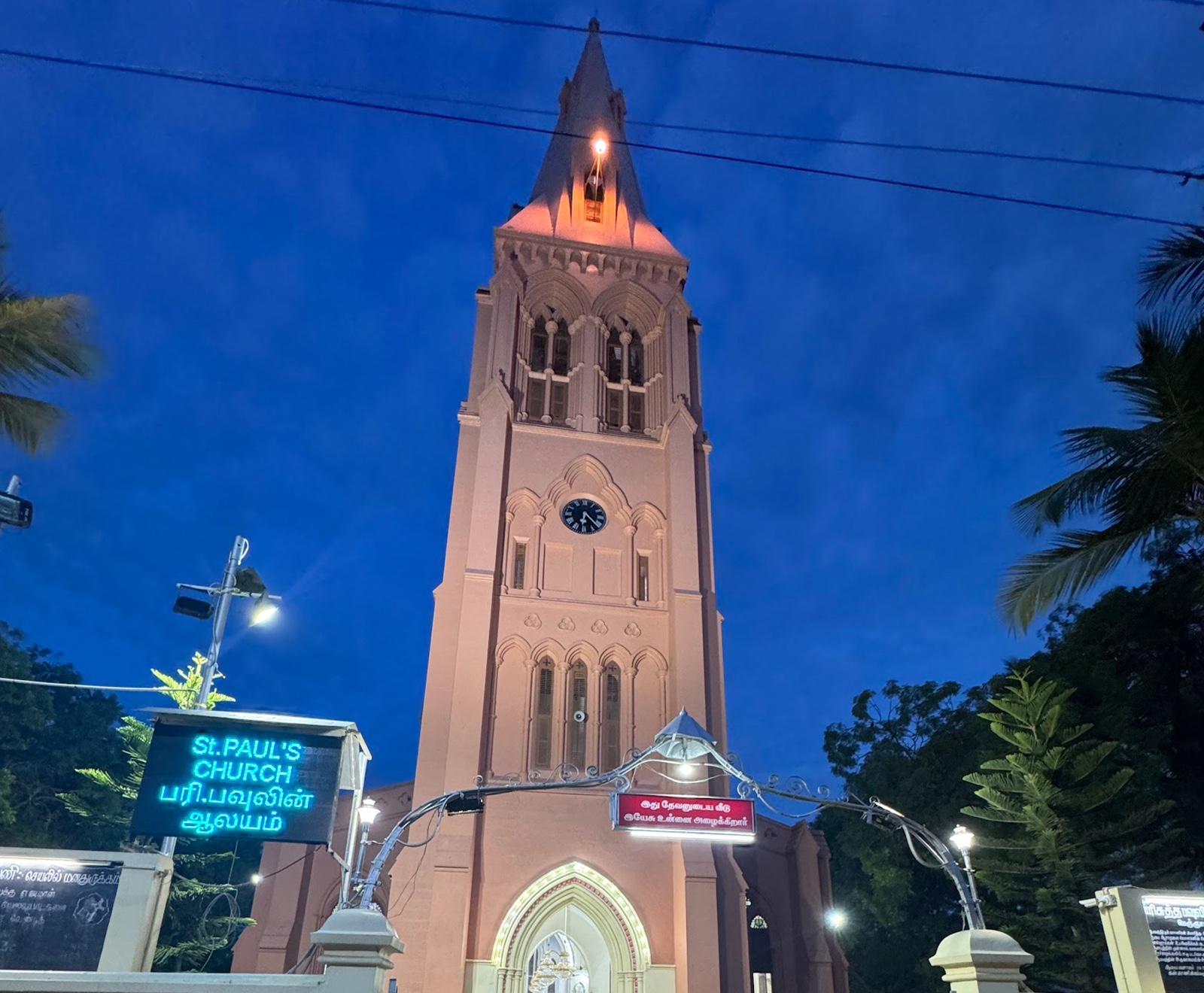
What this page covers
This is a history. It does not set out to prove a thesis. It tells the story of the Christian mission at Meignanapuram (also written Megnanapuram, Mengnanapuram and Meiññãnapuram; in Tamil மெய்ஞானபுரம்), in what is now Thoothukudi district of Tamil Nadu and was then the southern part of the Tinnevelly district of the Madras Presidency. It asks five things:
The scope of this page, stated narrowly
This page covers the Protestant (Anglican) mission at Meignanapuram and its immediate region. It mentions the older Catholic presence on the coast only where the Protestant sources do. It makes no comments about other religions, and where a source it quotes does, it does not repeat them. It treats the missionaries and the Tamil Christians with respect, records their disagreements fairly, and does not judge anyone’s motives. The last Part compares the nineteenth-century message with emphases common today, in general terms only; no living person, congregation or ministry is named or described, and every modern example is composed for illustration and labelled as composed.
What the page finds, stated up front
- The Tinnevelly church began with Tamil Christians. A Palayamkottai congregation of forty is on a register in 1780; Clorinda built its first church about 1783; a Tamil catechist, Sattianadhan, was ordained in 1790. Part II.
- Rhenius created the village and the system. His Native Philanthropic Society (1830) bought land for Christian settlements, and Neduvilai appears as “Menyanapuram, formerly Nedunvilei” in his journal by April 1831. His break with the CMS in 1835 had two causes, stated differently by the two sides. Part III.
- John Thomas organised a district of 125 villages. He trained and met his catechists every month, dug wells, laid out the village, and presented twelve Tamil catechists for ordination in 1869. He died on 28 March 1870 and is buried at the church. Part IV.
- The church was built in stages and was meant as a thank-offering. Pettitt says it was designed as “a memento, and as a thank-offering to God” for the healing of the 1835 division. Stock, writing in 1899, twice calls it St. David’s; it is now St. Paul’s, and the sources checked do not say when the name changed. Part V.
- Mary Thomas founded and ran the girls’ boarding school for six decades. “Elliott Tuxford” is the name of its English benefactor and his parish. By 1846 the mission employed forty-six schoolmistresses, most trained in schools like hers. Part VI.
- The Tamil workers were the backbone of the mission. Profile cards give what the sources record of twenty-five people and groups, among them Devasagayam, Paul Daniel, the catechist Thomas and Devanayagam Viravagu. Almost no Bible women are named in the sources checked, and the page says so. Part VII.
- The church grew by families and villages, and slowly. Converts were taught for “seldom … less than two years” before adult baptism. The district counted about 5,500 Christians in 1857, 11,000 in 1868 and 18,000 in 1880. Part VIII.
- The village’s schools changed it most visibly. In 2011 the census recorded 95 per cent literacy among those aged seven and over, women at 93.5 per cent. A widely repeated figure of “44.9 per cent” for women is a misreading of the same table. Part X.
- No source checked explains the date of the Asana Pandigai. The festival counts its years from 1847, yet falls in late January, beside the 1885 reopening on Mary Thomas’s birthday and the feast of the Conversion of St. Paul. The communal meal itself has a recorded ancestor on the day the foundation stone was laid. Part XI.
- The message was Christ crucified, taught by repetition and lived in daily worship. Reports full of cholera, famine and death contain no promise of health or prosperity for faith. Parts XII and XIII.
The prompt behind this page
Everything below was produced by giving the following brief to a frontier language model with web search, which assembled and checked the sources. It is published so you can run it yourself, change it, or point it at another place. Three experiments are worth more than reading this page. First, change the village: run it for Nazareth, Sawyerpuram, Idaiyangudi, Dohnavur or your own family’s village, and see what the record holds. Second, change the sources: ask for the story told only from Tamil sources, and see what the English reports leave out. Third, test the last Part: collect a month of sermons you have actually heard, and set them beside the catechism in Part XII.
Write a detailed, source-first, interactive history article, in
British English, for a general reader who is willing to work. Quote
Scripture from the Authorised Version. Date and attribute every
quotation: give the work, the edition, and the page or section where
possible. Verify every claim against primary and scholarly sources;
where a claim cannot be verified, say so, or mark it as local
tradition. Do not invent quotes. Check every claim marked "(verify)"
and say what you found.

  TOPIC. Meignanapuram, the "Town of True Wisdom": the mission, the
  missionaries, and what changed.

  This is a history article, not a thesis article. Tell the story of
  the Christian mission at Meignanapuram (also spelled Megnanapuram)
  in Thoothukudi district, southern Tamil Nadu. Cover the people who
  served there, what changed spiritually, educationally and
  economically, and the message they preached. Make no comments
  about other religions. Write with respect for everyone in the
  story.

  PERSONAL OPENING. Open with a short first-person account in the
  author's voice: he recently visited the village, the CSI church
  (St. Paul's), and the graves of John Thomas and his wife Mary; he
  was struck by the beauty of the church and became curious about the
  mission in the area.

  STARTING REFERENCE. The Wikipedia article on Megnanapuram, which is
  flagged as needing citations, so verify everything. It says C. T. E.
  Rhenius renamed Neduvilai as Meignanapuram ("True Wisdom") on
  7 March 1830; John Thomas designed the church and is buried there;
  the 192-foot steeple was added in 1868 with the coping stone set
  by Lord Napier; and the annual festival (Asana Pandigai) on the last
  Thursday of January draws more than 100,000 people. Write about the
  origins of the Asana Pandigai.

  QUESTIONS TO EXPLORE.
   1. The setting before the mission: the region (then Tinnevelly),
      its people, economy and social conditions in the early 1800s,
      factual and neutral. The earlier Protestant background:
      Tranquebar (Ziegenbalg, 1706), Schwartz, and the first
      Tinnevelly congregations, such as Clorinda's at Palayamkottai
      (verify).
   2. C. T. E. Rhenius: his background as a German missionary with
      the CMS; his work in Tinnevelly from 1820; the Christian
      villages he founded; his naming of Meignanapuram; his Tamil
      scholarship, Bible revision and schools; his later break with
      the CMS and its effect on the congregations, factually and
      without taking sides (verify the dates and causes).
   3. John Thomas: his origins (often described as Welsh), his
      arrival (around 1837-1838), his three decades of ministry until
      his death in 1870 (verify); how he organised the district and
      trained catechists; the building of the church (Gothic design,
      construction dates, funding, the 1868 spire, its name and
      dedication); why he is buried at the church; how the village
      remembers him (the festival, the college named after him, the
      sports clubs).
   4. Mary Thomas: her work for girls' education, the girls'
      boarding school and its connection to today's Elliott Tuxford
      Girls Higher Secondary School; who Elliott Tuxford was
      (verify); what girls' education meant in that time and place.
      Give her equal standing in the story.
   5. The Tamil catechists, pastors, schoolmasters and Bible women.
      Identify as many as the sources allow, including the first
      Tamil clergy ordained in the district; their training and role.
   6. How the church grew: the community-wide movements in
      Tinnevelly; what changed for people socially; new Christian
      villages; how converts were instructed, baptised and formed
      into congregations. Descriptive, not polemical.
   7. The regional picture, briefly: Robert Caldwell at Idaiyangudi
      (SPG), Edward Sargent at Palayamkottai, others in the
      Tinnevelly mission; the line from the CMS mission to the
      Tirunelveli Diocese of the Church of South India (1947) and the
      TDTA schools.
   8. What changed, spiritually, educationally and economically:
      worship, catechesis, Scripture in Tamil, church life; literacy
      and the schools (boys' and girls', Ambrose, Elliott Tuxford,
      the John Thomas College of Education) and the teachers they
      produced; employment, the professions, famine relief in
      1876-78 (verify local relief), irrigation and agriculture. Use
      the 2011 Census with care and show change over time where
      sources allow.
   9. The message they preached, from the missionaries' letters,
      reports, sermons, catechisms and the Tamil Book of Common
      Prayer: sin and grace, Christ crucified and risen, baptism and
      catechism, the Ten Commandments, the Lord's Prayer and the
      Creed, Sunday worship, Scripture reading, Christian conduct in
      family and work. Quote primary sources where possible.
  10. Then and now: compare that message, gently and in general
      terms, with emphases common in many churches now active in the
      wider region (healing and prosperity promises, revelations from
      individual preachers, the authority of a church's founder, the
      loss of catechesis). Name no church or preacher. Let readers
      compare the two side by side. Link the earlier articles on the
      message of Christ, prosperity teaching and pastoral authority.

  SOURCES TO TRY (verify each). CMS records, the Church Missionary
  Record and Register; Caldwell, Records of the Early History of the
  Tinnevelly Mission (1881); the Memoir of Rhenius by his son (1841);
  Stephen Neill, A History of Christianity in India; R. E.
  Frykenberg, Christianity in India; D. Dennis Hudson, Protestant
  Origins in India; Tirunelveli Diocese and CSI histories;
  inscriptions and records at the church.

INTERACTIVES. A priors quiz. An interactive timeline from Tranquebar
(1706) through Rhenius, John and Mary Thomas, the 1868 spire and the
CSI (1947) to today. A simple map of Meignanapuram and the mission
villages. Profile cards for the key people, including the Tamil
workers. Clearly marked places for the author's own photos of the
church, the spire and the graves. Exercises that make the reader
weigh evidence rather than only read it.

OUTPUT: a single self-contained interactive HTML page, professional
and readable, light theme by default with a dark switch, stating the
topic at the top, publishing this prompt in full, repeating the key
points in prominent boxes for readers who skim, explaining every
technical term in a box where it is used, and giving the reader
something to do in every major section. Propose a title that will
resonate. Also produce a plain-English quick version of about
fifteen minutes with three short exercises, and a Simple English
version with no exercises.
The page you are reading is the output of that brief after the sources were checked. Fourteen things corrected or qualified the brief or its starting reference. They are listed here, and marked again where they arise.
1. The date 7 March 1830 is local tradition; the name itself is confirmed by 1831. Rhenius’s journal for 14 April 1831 reads: “In the evening we reached Menyanapuram, formerly Nedunvilei.” No dated renaming appears in his published Memoir (1841). Stock (1899) says the village was one of the settlements founded by Rhenius’s Philanthropic Society and gives the meaning as “Village of True Wisdom.” Part III.
2. “1837–1838” is right on both counts. Thomas landed at Madras on Christmas Day 1836, first visited the district in 1837 and preached his first Tamil sermon there at Christmas 1837; the district was formally assigned to him in 1838, and he married at Madras that October. He died at Meignanapuram on 28 March 1870: “exactly one-third of a century,” in Stock’s phrase. Part IV.
3. Welsh, yes; the parish is uncertain. Frank Penny (1904) says he “was born in Wales in 1807,” and his death was announced in the Pembrokeshire Herald (13 May 1870). Family and local sources differ on the parish, naming Pembroke and Trelech in Carmarthenshire. Part IV.
4. The foundation stone was laid in June 1843, not 1844. Pettitt, who was present, places it among the events of 1843 and gives the evening of 20 June; Holcomb (1888) gives 26 June 1843. Local histories give 20 June 1844. Part V.
5. The church was opened in 1847 and finished in 1885. Stock’s chronology lists “1847—Mengnanapuram Church opened.” The top stone of the spire was set in October 1868, but “the roof was still of thatch”; the church was reopened, complete, on 22 January 1885. Part V.
6. The 1868 ceremony is confirmed, with Lady Napier. Stock: “The top-stone of its lofty spire was raised to its place in October, 1868, on the occasion of the visit of the Governor of Madras, Lord Napier of Merchistoun, with Lady Napier.” Part V.
7. The 192-foot height is a modern figure. Bishop Spencer, shown the plans in 1845, gave “the tower and spire one hundred and seventy-five feet.” The figure of 192 feet appears in local and modern sources; no survey was found. Part V.
8. The church’s name has a question attached. Stock (1899) writes that Thomas, “like a true Welshman,” named it “St. David’s,” and later calls it “St. David’s Church, Mengnanapuram.” Pate (1917) and every modern source call it St. Paul’s. No source checked records a change. Part V.
9. No source checked explains why the festival falls in late January. The evidence is set out in Part XI, and the page does not claim more than it shows.
10. “Elliott Tuxford” was not a person. Pettitt: the school’s funds “were contributed chiefly by the Rev. E. B. Elliott, and the people of Tuxford, and is called the ‘Mary Elliott Tuxford Girls’ School.’” Stock adds that it was named “in memory of the deceased wife of E. B. Elliott of Brighton, formerly Vicar of Tuxford.” Part VI.
11. Mary Thomas’s maiden name and exact dates were not found. The sources give her birthday (22 January), her marriage at Madras in October 1838, and her death about 1900, “thirty years” after her husband. Part VI.
12. The break with Rhenius had two causes, told differently by each side. A proposal to ordain Tamil catechists by the Lutheran rite, which the CMS declined because an Anglican bishop was now available; and two pamphlets by Rhenius against the Prayer Book and the constitution of the Church of England. The CMS dissolved its connection with him in 1835. Part III.
13. Famine relief: regional, and the local record is of volunteers. CMS relief in 1877 was spent mostly in Tinnevelly. The sources checked do not give relief figures for Meignanapuram itself; they do record a meeting there at which 124 men, then 38 more, and 7 women volunteered to teach one day a week. Part VIII.
14. The 2011 Census needs care. The village (code 642581) had 2,502 people and 95.1 per cent literacy among those aged seven and over. The figure of 44.9 per cent sometimes given for women is literate women as a share of the whole population, men and children included. A second census unit of the same name has 777 people. Part X.
What do you currently know?
Ten questions. Each has an answer you can check in the sources listed in Part XV. Answer them before reading and lock them in. They come back in Part XIV with the evidence beside them.
What follows
The whole story on one line
Three hundred and twenty years in thirty-four steps. Click any dot, use the arrows, or switch to the list. Filter by period to follow one thread. Each entry gives its source; where a date rests on local tradition rather than an older record, the entry says so.
Try it: put six moments in order
Before reading on, arrange these six events from earliest to latest with the arrows, then check. The answer often surprises people who know the church: it was in use for decades before it was finished.
Before the mission
In 1800 the far south of the Tamil country was a district of contrasts. Along the Tambraparni river ran a narrow ribbon of irrigated rice land with old towns and temples. To the north lay the black cotton soil. To the south and south-east, between the river and the sea, stretched the teri, a country of red sand dunes and scrub, where little would grow except the palmyra palm. Meignanapuram lies in that country, “in the heart of the ‘palmyra forest’ at the foot of the Kuthiraimoli teri,” as the 1917 district gazetteer puts it.
“It was in the midst of a desert of sand, occupied only by palmira-trees, castor-oil shrubs, and thorn-bushes, with here and there a banyan, marking the road to Trichendoor. … during the season, when the land-wind, rushing from the mountains, parches the country, and sweeps the falling leaves before it, the village was continually involved in clouds of sand and dust.”
George Pettitt, describing Meignanapuram as it was when John Thomas arrived, The Tinnevelly Mission of the Church Missionary Society (London, 1851), Letter IX, p. 326.
Politically, the district passed fully to the East India Company in 1801, after years of war with the local chiefs known as palaiyakkarar (poligars). Socially, it was a society in which rank was fixed by birth, and in which occupation, dress, marriage and many daily arrangements followed that rank. The palmyra climbers, the Shanars (today Nadars), lived by the tree: they climbed it twice a day to collect its sap, which was boiled into jaggery or sold as toddy, and used its leaves, timber and fibre for almost everything else. Pettitt, writing of the palmyra in 1835, thought it “a most useful tree,” showing “the peculiar care of Divine Providence toward those whose lot is cast in a barren land.” Most of the families who became Protestant Christians in this part of the district came from this community, though the registers show members of many others. Cholera, drought and occasional famine were regular visitors; the mission reports record all three.
The Protestant church in Tinnevelly began without a resident missionary
The Protestant story in South India begins at Tranquebar (Tharangambadi), a Danish trading post on the coast about three hundred kilometres north-east. On 9 July 1706 two German Lutherans sent by the King of Denmark, Bartholomaeus Ziegenbalg and Heinrich Plütschau, landed there. Ziegenbalg learned Tamil, printed the first Tamil New Testament (1714), and began schools. The mission’s later and greatest figure, Christian Friedrich Schwartz (1726–1798), worked from Trichinopoly and Tanjore and made several journeys south.
The first Protestant congregation in Tinnevelly gathered around a woman. In 1778, at Palayamkottai, Schwartz baptised a widow from Tanjore who took the name Clorinda. A church register of 1780 lists forty members of the Palayamkottai congregation, of many different communities. About 1783 Clorinda led the building of a small church in the fort, “by the pious aid of two English gentlemen,” in Schwartz’s words; Caldwell calls it “the first Church erected in connection with the Tinnevelly Mission.” It still stands, much rebuilt.
“There is a wide field here. O let us pray for faithful labourers. May God send us such for Christ’s sake, yea may He send such labourers in troops.”
C. F. Schwartz, letter from Palamcotta to Pohle, 4 March 1778, as quoted in Robert Caldwell, Records of the Early History of the Tinnevelly Mission (Madras, 1881), ch. I, p. 8.
For the next forty years the Tinnevelly Christians were cared for mainly by Tamil catechists, visited at intervals by missionaries from Tanjore. The most important was Sattianadhan, a catechist sent in 1785 and ordained on 26 December 1790 by the Lutheran missionaries: the first Tamil minister in the province. From 1797 a movement began among the Shanars of the south-east, and whole families asked for instruction. Christian villages were founded for them: Mudalur (“first town”) in 1799, and Nazareth, whose site the missionary J. C. Kohlhoff bought in 1803. Nazareth and its later missionary Arthur Margoschis are the subject of Dossier 07.
When the first resident English and German missionaries reached Tinnevelly, there was already a Tamil church there, with Tamil teachers, Tamil registers and a Tamil minister.
Rhenius and the town of true wisdom
Charles Theophilus Ewald Rhenius was born on 5 November 1790 at Graudenz in West Prussia (now Grudziądz in Poland). He trained at Johann Jänicke’s missionary seminary in Berlin, was ordained a Lutheran minister in 1812, and was taken on by the Church Missionary Society, which in its early years recruited German Lutherans because few English clergy volunteered. He reached Madras in 1814 and moved to Palamcottah in 1820. He stayed in Tinnevelly, with one interruption, until he died there on 5 June 1838.
What he built
Rhenius was a preacher, a translator and, above all, an organiser. In fifteen years he built a system that outlasted him. The pieces, with the sources’ dates:
The numbers grew with the system. In 1829 the missionaries reported “6000 persons under instruction, of whom 984 were baptized”; by 1835, “more than ten thousand Natives, men, women, and children, brought under Christian instruction” (Pettitt).
How Neduvilai became Meignanapuram
The village was one of the new settlements. Its older name was Neduvilai (Nedunvilai), a vilai or hamlet name common in the teri country. The Christians who settled there were given a new name for it, as at Pragasapuram (“town of light”), Suviseshapuram (“town of the Gospel”) and Nazareth before them. Mei is “true” and ñãnam “wisdom” or “knowledge”: the town of true wisdom. Rhenius liked the phrase. His Tamil tracts were addressed “To the Tamul people who desire true wisdom,” and a visiting teacher told him he had heard of him as one “teaching the way of true wisdom.”
“In the evening we reached Menyanapuram, formerly Nedunvilei. This village does not yet appear to be so happy as K——. The heat was very oppressive; the chapel full. About a dozen persons were to have been baptized; but on examining them they were … [not ready], that I deferred the baptism. I baptized some of the Christians’ children only. The people were exhorted, admonished, and encouraged.”
C. T. E. Rhenius, journal, 14 April 1831, in Memoir of the Rev. C. T. E. Rhenius, by his son (London, 1841), p. 399. The earliest dated use of the new name found for this page. The bracketed words replace a phrase about the candidates’ dullness in the heat.
The starting reference gives 7 March 1830. That date is repeated in local histories and on the church’s own pages, but it was not found in Rhenius’s published journals. What the record shows is that the new name was in use by April 1831, and that by 1835 it had already “given its name to the district” (Pettitt, p. 167). The 1830 date is plausible, since the Philanthropic Society was formed that year; treat the exact day as local tradition until a primary record turns up.
The break of 1835, told from both sides
Rhenius’s work ended in a painful division. The facts are not in dispute: in 1835 the CMS dissolved its connection with him; his three German colleagues, Schaffter, Müller and Lechler, resigned with him; and for about three years the Tinnevelly congregations were split between the CMS mission under George Pettitt and an independent “German Evangelical Mission” that Rhenius led from Palamcottah after returning in 1836. What the two sides said the quarrel was about is set out below in their own words. This page does not adjudicate between them.
Rhenius’s letter also names, among the points the Tamil candidates could not accept, the Prayer Book’s statement that a child is in baptism “made a member of Christ, the child of God, and an inheritor of the kingdom of heaven.” That is worth noticing, because the same Prayer Book, in Tamil, was what the CMS congregations of Meignanapuram used for the next century. The founders of the mission did not all agree about baptism; Part XII returns to this.
The effect on the people was real. Pettitt describes “the long course of division.” Stock, writing for the CMS, says three-quarters of the congregations stayed with the Society. But the Meignanapuram district, in Pettitt’s words, was “less afflicted than the rest by division,” which is one reason it was ready to be made a separate district. Rhenius died on 5 June 1838, “lamented, for his zeal and earnestness, by all parties” (Stock). The Society at once offered his widow the support she would have had if he had died on its roll; his eldest son later trained at Islington and returned to Tinnevelly as a CMS missionary; Schaffter and then Müller rejoined; and the division healed. When the foundation stone of the Meignanapuram church was laid in 1843, Pettitt says it was laid as “a memento, and as a thank-offering to God, for His goodness in bringing about this happy state of things.”
Exercise · who said it?
Six statements about the 1835 break. For each, say whose account it comes from, or whether both sides would accept it. The page’s answer appears when you choose.
0 of 6 sorted.
Rhenius gave Meignanapuram its name, its first congregation and the system that made it grow. The quarrel that ended his work was about ordination and the Prayer Book, and each side described it in its own terms.
John Thomas: thirty-three years
John Thomas was born in Wales in 1807. Frank Penny’s Church in Madras (1904) gives the outline: he was at the CMS College, Islington, from 1833 to 1835, was ordained deacon by the Bishop of London in 1835 and priest by the Bishop of Gloucester in 1836, “and went at once to Tinnevelly.” He sailed in 1836 and landed at Madras on Christmas Day. Penny adds that, “like so many of his countrymen he was a skilled musician with an attractive singing voice,” with “a good working knowledge of architecture and a remarkable taste in designing and town planning.” Bishop Spencer heard that voice in 1845, when a congregation sang “to the air of Luther’s celebrated hymn, Mr. Thomas leading his people with his magnificent voice.”
He landed at Madras on 25 December 1836. He first visited the Meignanapuram congregations in 1837 and preached his first Tamil sermon there on Christmas Day 1837. The district was formally assigned to him in 1838, after the death of Rhenius; for a time he supervised it from Palamcottah and Satankulam before living in the village. He was Welsh; family and local sources disagree on the parish (Pembroke, or Trelech in Carmarthenshire), and this page leaves it open.
Why Meignanapuram
“In drawing up my first Report of this district, I cannot refrain from expressing my gratitude to Almighty God, for that arrangement of his good providence, by which so interesting a portion of the Mission has been committed to my care. It was the first district that I visited after my arrival in the country; probably for this reason, (and because it was here that I first saw the actual effects of the Gospel in a heathen land, and the state of our converts,) I have felt a higher degree of interest in it than in any other division of the Mission, and a greater degree of affection for the people.”
John Thomas, first half-yearly report of the Meignanapuram district, end of 1838, quoted in Pettitt, The Tinnevelly Mission (1851), Letter V, pp. 168–169. In the same report he records eighteen catechists, and twenty-nine adults and infants baptised at Christmas “after careful examination.”
Pettitt explains the choice. Meignanapuram “was not the largest in the district, nor the most promising,” but it was central, and Pragasapuram, the larger village, was too close to the SPG station at Nazareth. Bishop Spencer, who knew Thomas well, adds the reason Thomas himself gave: “very little could be accomplished by the occasional visits of a missionary residing at Palamcottah; whilst there was good reason to hope that … much might be achieved by a faithful man resident continually among the people.”
Water, streets and a district
The first thing Thomas did was dig wells. The local people called the place saba nilam, “soil under the curse”; within a few years Pettitt was describing “one of the most sandy deserts I ever saw” turned “into an oasis, where every thing grows abundantly, including even grapes and pine-apples.” He then laid out a new village with broad streets, and in time did the same “on a smaller scale” for the villages around (Penny). Holcomb, visiting in the 1880s, found “a broad street with rows of feathery palms on either side.”
His real work was the district. By 1845 it had twenty-seven village chapels or prayer-houses, “all of which, with but one exception, have been erected during Mr. Thomas’s incumbency,” with “one-third of the expense, on an average, … contributed by the people” (Spencer). He founded a church-building fund among his catechists, and the congregations took it up “with enthusiasm.” In 1857, reviewing twenty years, he counted 5,500 Christians; two years later, more than 10,000. His last retrospect, in 1868, gave 125 villages with resident Christians, about 11,000 professing Christians, small churches or prayer-houses in all the larger villages, schools “every one of them taught by Christian teachers only,” and fifty-four Tamil catechists “acting as quasi-pastors of the little bands of Christians.” Stock concluded that “practically Thomas was a bishop, in everything except the performance of distinctively episcopal functions.”
“I cannot account for the great change in the moral wilderness around me, compared with what it was twenty-one years ago, upon any other principle than that of a Divine and gracious influence poured upon us from on high. The full attendance at our churches and prayer-houses—the attentive and solemn interest with which our people listen to the preached word—the increase in the number of our communicants—the far higher standard of attainments and piety among the catechists—the vigorous working of our schools by a trained agency—the intelligent piety of the younger members of our congregations—all these show most clearly that the work is the Lord’s; and considering all things, it is marvellous in our eyes.”
John Thomas, report of about 1858–59, quoted in Stock, History of the CMS, vol. 2 (1899), pp. 180–181.
How he trained the catechists
Thomas used the method common to the CMS stations in Tinnevelly, which Pettitt describes in detail. Promising young men from the congregations, “from eighteen to twenty-eight years of age,” joined a preparandi class at the station for six to twelve months. They studied “Scripture history and theology, with something of general knowledge,” with the missionary for an hour or two each day, recited a portion of Scripture daily to the inspecting catechist, and on Saturdays went “two by two, to the neighbouring villages, furnished with a few tracts, which they read, explain, and give away.” Then they were sent out as assistant schoolmasters or readers, “on a salary … exceedingly moderate,” and rose through the grades.
Once a month every catechist came in to the station. The pattern, in Pettitt’s account:
Thomas also worked to make the Tamil church govern itself. He pressed for more ordained Tamil clergy, presented twelve of his catechists to Bishop Gell for ordination in January 1869, and supported the system of local church councils under which Tamil pastors were ordained “on the title of the native Church Councils” rather than as employees of a foreign society.
His death and his grave
Little more than a year after the Governor’s visit of October 1868, Thomas fell fatally ill. He was nursed by the medical missionary of the SPG at Nazareth, Dr. Strachan, and died at Meignanapuram on 28 March 1870. “Round his grave gathered the twelve Tamil clergymen, and a host of the people to whom he had been, not only a messenger from God, but a father and a friend” (Stock). He was buried at the church he had built; Holcomb wrote that he left it “as his monument, and beneath its shadow he sleeps, waiting for the morning of the resurrection.” Local tradition says the people asked that he be buried there. At his dying request his eldest son, the Rev. J. Davies Thomas, succeeded him in the district.
The village remembers him in names. The college of education for women is the Rev. John Thomas College of Education. The sports clubs for which the village is known, kabaddi above all, carry his name too, and the kabaddi club has produced national players. Each year at the festival in January the people pay their respects at his memorial.
Thomas came to a sand-blown hamlet with eighteen catechists and left a district of 125 villages, fifty-four catechists and twelve Tamil clergy, most of them trained by the monthly round of study he kept up for thirty years.
The church in the sand
When Bishop Spencer of Madras first visited Meignanapuram in January 1841, he preached in “the small and low room, thatched with palmyra leaf” that served as its church. Two hundred and seventy-two people were confirmed there on that visit, the first confirmations ever held in the province. Four years later he came back and found something else.
“On entering the village, I hastened to look at what will be, when completed, the noblest Mission Church in Southern India, and will deserve to be called the Cathedral of Tinnevelly. The style is the Gothic … The nave is to be ninety feet by fifty-eight; the chancel twenty-four by twenty; the small transepts fifteen by fifteen; the tower and spire one hundred and seventy-five feet. Will not this be a noble church? But it will not be larger than is required by the congregation; as there seems to be no doubt that one thousand souls will be collected here every sabbath-day. … Meignanapoorum spire will be a conspicuous object in this flat country at a considerable distance, comforting the Christian … that of a truth the Gospel is in this place.”
G. T. Spencer, Bishop of Madras, journal, September 1845, in Journal of a Visitation Tour … through the Provinces of Madura and Tinnevelly (London, 1846), pp. 78–79.
Forty-two years in five stages
The church was not built in one campaign. Most of the confusion about its dates comes from treating several events as one. Here they are separately.
The foundation stone belongs to June 1843: Pettitt was there and dates it among the events of that year, and Holcomb independently gives 1843. The church was opened in 1847, not completed in 1868; the spire’s top stone was set in October 1868 in the presence of Lord and Lady Napier, but the building was finished only when its permanent roof went on, and it was reopened on 22 January 1885. The spire’s height is planned at 175 feet in 1845; the familiar 192 feet is a modern figure, not checked against a survey. The 1985 centenary souvenir of the church celebrates the centenary of the 1885 reopening.
Who paid, and why it was built so large
Pettitt gives the reason in a sentence that is easy to miss. The church “had been designed as a memento, and as a thank-offering to God, for His goodness in bringing about this happy state of things”: the end of the division after Rhenius. “It was also deemed advisable in this case, to exceed what will be the ordinary expense of Church-building in Tinnevelly for years to come, in order to erect a Church which should serve as a kind of model for others.” The money came from three places: “A considerable amount of funds was already raised, or promised by friends; only a small portion was allowed by the Committee, and the Native Christians of the district also were prepared to offer liberal contributions toward it.” Penny credits the church itself to “the liberality of the Rev. E. Elliott of Tuxford.” A 1985 Tamil souvenir gives a total of about eleven thousand rupees, of which the congregation gave more than nine hundred; that figure is local and is given here as such.
Thomas, who had never built anything so large, went to Kottayam in Travancore to consult the CMS missionary Benjamin Bailey, “who had already erected a substantial gothic Church there.” The stone is the cream-coloured Pannamparai stone, “in great demand in the south of the district” (Pate, 1917), quarried “in the neighbourhood, in large blocks” (Spencer). Local tradition adds that the mortar was mixed with boiled palm sap, that a London architect revised Thomas’s design, and that the bell was shipped from England and dropped and mended on the way; none of these was found in the older sources, and they are recorded here as tradition.
“After an affectionate address from him, translated into Tamul also, the proceedings closed as the sun descended behind the distant ghauts, with a hymn in the Native language; and shortly afterward, two thousand Native Christians sat down in an adjoining field, and were regaled with a feast of excellent curry and rice.”
George Pettitt, on the laying of the foundation stone, 20 June 1843, The Tinnevelly Mission (1851), p. 328. Part XI returns to this meal.
St. David’s, or St. Paul’s?
The church is today St. Paul’s, and so it was in the district gazetteer of 1917. But Eugene Stock, the CMS’s own historian, writing in 1899 from the Society’s records, says otherwise, and says it twice:
“… the opening of his splendid church, with its tower and tall spire, which remains to this day the finest in South India. Like a true Welshman as he was, he named it St. David’s.” And later: “certainly few of them had such a cathedral as St. David’s Church, Mengnanapuram!”
Eugene Stock, The History of the Church Missionary Society, vol. 2 (London, 1899), pp. 180, 542.
Either Stock was wrong, or the church was renamed at some point between Thomas’s time and the early twentieth century, perhaps at the 1885 reopening. No source checked for this page records a rededication. This is a question a visitor can help answer: the foundation stone, the bronze and wall inscriptions, the memorial tablets to Thomas, his wife, their son and Ashton Dibb, and the church’s registers may name the patron.
Exercise · which year?
Six events in the life of the building. Pick the year for each, then read what the sources say.
0 of 6 answered.
The church was begun in 1843 as a thank-offering for a healed division, used from 1847, crowned with its spire in 1868 and finished in 1885. The people of the district helped pay for it, carried its sand and gave the palmyras for its scaffolding.
Mary Thomas and the girls’ school
Mary Thomas lived at Meignanapuram longer than anyone else in this story: about sixty years, as wife and then as widow. She married John Thomas at Madras in October 1838, in the months when he was taking charge of the district, and came to the village with him. Her maiden name and the year of her birth were not found in the sources checked for this page. Her birthday was 22 January, because the church was reopened on it in 1885. She survived her husband by about thirty years and died at Meignanapuram around 1900, “a mother in Israel” to the last, in the words of the CMS history. She lies beside him at the church.
The school
She began a school for girls almost at once. Local histories date its beginning to 1841; the gazetteer of 1917 dates the boarding school to 1842. The building came next: its foundation stone was laid on the same June evening in 1843 as the church’s, and because it was finished first, “served for a long time as a place of worship also” (Pettitt). Spencer saw it in 1845: “a school-room already built, in excellent taste … Here, also, the Gothic has been most appropriately and happily adopted.” Pettitt says the large boarding school at Meignanapuram was formed by “Mrs. Thomas and Miss Hobbs (now Mrs. Spratt).”
What it meant for a girl to go to school
In the Tinnevelly of the 1830s and 1840s, very few women of any community could read. The missionaries’ first problem in teaching girls was that there were no women to teach them. Pettitt describes the solution: boarding schools at the mission stations, where girls chosen from the village schools lived, studied and were trained, so that they could go back as teachers and as wives of catechists. By the end of 1846 the mission employed forty-six schoolmistresses, “most of whom were educated in these schools,” and its schools held 1,578 girls to 4,176 boys. A normal school for training schoolmistresses was opened at Kadachapuram by Miss Giberne in 1845.
The visitors noticed what the girls had learned. Bishop Spencer, examining the Satankulam schools a few miles away in 1845, found the girls “manifested a very creditable knowledge of the way of salvation. The boys likewise acquitted themselves well, although their knowledge is apparently not so extensive as that of the girls.” Holcomb, visiting Meignanapuram in the 1880s, describes “the more promising daughters of the Christian natives from the district” selected from the village schools for the boarding school, which was Mrs. Thomas’s and her daughter’s “especial care.”
The school also became a source of work. By 1917 the district gazetteer could note that Miss Thomas, “a daughter of the founder of the place, still superintends the girls’ school and the embroidery work for which the place is well known.” She ran the school for nearly fifty years. Mother and daughter between them managed it for more than six decades.
Mary Thomas founded the girls’ school in the village’s first years and ran it, with her daughter after her, for more than sixty years. Its name records an English vicar, his late wife and his parish, who paid for its first building.
The people of the story
Mission histories are written mostly by missionaries, so they are full of missionaries. But almost every village congregation in this story was gathered, taught and led day to day by a Tamil catechist, and almost every school was taught by a Tamil schoolmaster or schoolmistress. Pettitt, who trained hundreds of them, describes them with unusual warmth.
“In times of Cholera, I have never known them forsake the villages where it has broken out, or refuse to visit those attacked by it, notwithstanding, that several among their body have thus fallen victims. I remember the case of a Catechist who took the disease in attending the sick, and was buried by the Catechist of a neighbouring village; who, being likewise attacked, was buried in the same grave on the following day.”
George Pettitt, The Tinnevelly Mission (1851), Letter XV, p. 541.
The catechists were graded: assistant readers and readers, assistant catechists and catechists, and inspecting catechists over them, with schoolmasters alongside. Their pay, Pettitt says, was on average “not more than the pay of our domestic servants,” deliberately, so that they were not “raised much above their own relatives and friends.” A widows’ fund supported their families when they died. Some were ordained. The first Tamil minister in Tinnevelly was Sattianadhan, ordained in 1790; the first in the Church of England’s orders in South India was John Devasagayam, made deacon in 1830; by 1880 the Meignanapuram district alone had twenty-one Tamil pastors.
A gap in the record: the Bible women
The brief asked for Bible women by name. The sources checked for this page record schoolmistresses by number (forty-six in 1846), catechists’ wives as a class, and seven women who stood up at Meignanapuram in 1877 to volunteer as teachers, but they name almost none of them. The later CMS and Zenana society reports, the diocesan archives at Palayamkottai and family memory in the village are where those names are most likely to be found. If you know them, they belong on this page.
Filter the cards by role. Each gives what the sources record, and where it comes from.
The missionaries planned and supervised; the Tamil catechists, schoolmasters and schoolmistresses did the daily teaching in every village, often for decades, and some of them gave their lives doing it.
How the church grew
The Tinnevelly church did not grow chiefly by individuals leaving their families. It grew by families and whole villages asking, together, to be placed under Christian instruction. Historians have called these “mass movements” or “community movements.” The first began among the Shanars of the south-east in 1797; there were large accessions in the 1820s and 1830s under Rhenius, again in the early 1840s, and again after the famine of 1877. In the first half of 1841 alone, Pettitt records, “in the Meignyanapuram district, the increase during the half-year ending June 30 was no less than 2000 souls, including several large villages.”
What happened next was slow, and the missionaries meant it to be. Pettitt, describing the practice of the whole CMS mission in 1851, sets it out step by step.
How long do you think an adult in this mission usually waited between asking for instruction and being baptised?
Move the slider to your guess, in months, then reveal what Pettitt wrote.
The numbers, and what they did and did not mean
The Meignanapuram district grew steadily under Thomas and his successors. The figures below are those the missionaries reported; they count “adherents,” baptised and unbaptised together, and the missionaries themselves warned against reading them as a count of the converted. The CMS Committee told its supporters “to rejoice in what the Lord had done, but with trembling,” and Stock notes that totals “continually varied as persecution raged and waned.”
The famine of 1876–78
The Great Famine of 1876–78 struck the Madras Presidency hard. The CMS placed £10,000, and then £7,000 more, at its Indian committees’ disposal; they spent less than £10,000, and “of the amount spent, the greater part was for relief in Tinnevelly, where the people, though they did not die, were reduced to great straits”; the SPG, whose districts were worse affected, spent more. Relief was given, Stock says, to those who were not Christians “as freely” as to those who were. In the months afterwards some ten thousand people in the CMS districts and twenty thousand in the SPG districts placed themselves under instruction. Stock is careful about what this meant: friends in England spoke of “Pentecostal scenes,” critics in India of “rice Christians”; in his judgment most of the newcomers had been moved by neither, and “what was now needed was a large band of teachers to go among them and instruct them.”
“At Mengnanapuram a large meeting was held in the church, which he addressed earnestly, and then asked those to stand up who would undertake to give one day a week to going among the new accessions or the surrounding Heathen. One hundred and twenty-four men instantly stood up; and, on a further appeal, thirty-eight more. Then the Bishop called on the women, and seven stood up.”
Eugene Stock, on Bishop Sargent’s appeal after the famine, History of the CMS, vol. 3 (1899), p. 173.
The sources checked record CMS relief across Tinnevelly in 1877 and the Meignanapuram volunteers, but no relief figures for the village itself. The 1880 accounts of the Meignanapuram Church Council, printed by Stock, may hold more for anyone with access to the CMS archives at Birmingham.
What changed socially
The sources record several changes in the lives of the families who became Christian. They are given here as the sources give them, without comparison.
Families and villages came together, but each person was taught for a long time before baptism, and the mission counted its people cautiously. The growth of the 1870s and 1880s depended on Tamil volunteers who taught one day a week.
The map and the wider mission
Meignanapuram is one village in a crowded mission landscape. Within a day’s bullock-cart journey lay the SPG stations of Nazareth, Mudalur, Sawyerpuram and Idaiyangudi, and the CMS stations of Satankulam and Palamcottah. Click a marker for what happened there. Positions are from modern coordinates; the coastline is drawn approximately.
Off the map: Tranquebar (1706) and Tanjore, Schwartz’s base, lie about 300 km to the north-east. Kadachapuram, Suviseshapuram, Pannaivilai and Christianagaram, all named on this page, are not shown because their positions could not be confirmed for this page.
The regional picture, briefly
Two societies of the Church of England worked side by side. The SPG inherited the older Tanjore mission’s congregations (Mudalur, Nazareth) and worked mainly in the south-east; the CMS, Rhenius’s society, held the greater part of the district. Their congregations were mixed together until, in 1844 and the years after, the missionaries on the ground agreed boundaries “by the sanction of authority”: Thomas at Meignanapuram with Caemmerer at Nazareth, Sargent at Suviseshapuram with Caldwell at Idaiyangudi. They shared ordinations, training and, often, friendship.
Meignanapuram grew up beside Nazareth, Sawyerpuram and Idaiyangudi, in a mission shared by two societies that divided the ground, trained together and in 1896 came under one bishop. The line runs from Rhenius’s CMS mission to today’s Church of South India.
What changed
The brief asked what changed spiritually, educationally and economically. The sources are rich on the first two and thin on the third, so the page says what it can and marks what it cannot.
| What the record shows | Where to look further | |
|---|---|---|
| Worship and church life | Daily morning and evening prayer in the village prayer-houses; Sunday worship from the Tamil Prayer Book; regular Communion after preparation; confirmation from 1841; a large church opened in 1847; 736 communicants at one service in 1885; twenty-one Tamil pastors in the district by 1880; a church council that paid them. | Diocesan and pastorate registers; the 1880 council accounts (Stock, vol. 3, p. 176). |
| Scripture and teaching | The Tamil Bible in successive revisions (Fabricius, Rhenius, the Union version); the catechism learned by heart; Watts’s Scripture History in Tamil for catechists; sermons on the Creed; hymnbooks; children carrying “the Psalter, the Hymn-book, and sometimes … the New Testament under their arm.” | Pettitt, Letter XV; Tamil Bible editions on archive.org. |
| Schools | Girls’ school (1841/42) and the Elliott Tuxford boarding school (building 1843); boys’ school (1846/47), a high school with boarders by 1917, now the Ambrose Higher Secondary School; the Esther Santham Higher Secondary School; TDTA primary schools; the Rev. John Thomas College of Education for women. Many villagers became teachers. | Pate (1917), ch. X; school histories; the 1997 sesquicentenary souvenir. |
| Land, water and work | Wells and gardens from the late 1830s; a planned village with broad streets; a dispensary from 1869; the Sadaiyaneri tank and channel as the village’s irrigation source, its bank “reduced … to ruin” in one great flood Pate records; embroidery work by 1917; in 2011, a working population mostly outside agriculture. | Pate (1917); the Census of India; family histories of migration and professions. |
Reading the census carefully
The 2011 Census of India counts the village of Megnanapuram (code 642581) at 2,502 people in 649 households. That is the figure to use, but two cautions apply. First, a second census unit with the same name in the same taluk has 777 people; make sure you are reading the right one. Second, literacy can be stated several ways from the same table, and the way it is often quoted is misleading.
The census table for Megnanapuram gives: 2,502 people, of whom 1,311 are women; 231 children aged 0–6, of whom 109 are girls; 2,160 literate people, of whom 1,124 are women. What share of the village’s women can read?
The census counts literacy among people aged seven and over. On that basis Megnanapuram’s literacy in 2011 was 95.1 per cent, 96.9 for men and 93.5 for women, well above the Tamil Nadu average of about 80 per cent. The “86.3 per cent” and “44.9 per cent” figures in some online summaries divide by the whole population, children included, and in the second case divide literate women by men and women together.
Change over time, where the sources allow
The district statistics point the same way. The gazetteer of 1917 placed Tinnevelly fourth among the districts of the Madras Presidency for literacy, and named Meignanapuram among the remote villages with a mission high school. A century later, a village that was sand and palmyra in 1838 records near-universal literacy among women as well as men, and a working population most of whom earn their living outside the fields. The page does not claim that the mission alone caused this; but the schools that produced the generations of teachers the village is known for are the ones Mary and John Thomas founded.
The deepest visible change is education, above all for women. Read correctly, the 2011 Census shows 93.5 per cent of the village’s women aged seven and over can read.
The Asana Pandigai
Every January Meignanapuram fills. People whose families come from the village return from Chennai, Bengaluru, the Gulf, Singapore, Britain and America; neighbours of every faith come too. The festival is known as the Asana Pandigai, “the feast of the asanam,” and on the church’s own reckoning as its consecration festival (pratishtai pandigai). Its heart is a service of Holy Communion in the early morning and, in the afternoon, the asanam: a meal of rice and curry cooked in great pots from dawn and served to everyone who comes, often reported at more than a hundred thousand people. In 2026 it fell on Thursday 29 January and was announced as the 179th.
Where it came from: what the sources show
No source checked for this page explains, in so many words, how the festival began or why it is held on the last Thursday of January. What the sources do provide is five pieces of evidence. Rate each one before reading the page’s view.
0 of 5 rated.
The page’s reading, offered as the most likely account
The meal is the oldest part: a feast for two thousand people followed the laying of the foundation stone in 1843, and the custom of an asanam at church dedications is shared across the region. The count runs from the opening of the church in 1847, which is why the festival is called a consecration festival. The date in late January is best explained by the great reopening of 22 January 1885, chosen for Mary Thomas’s birthday, and by the Prayer Book’s feast of the Conversion of St. Paul on 25 January, the church’s patronal day under its present name; the custom of a Thursday may have grown later. Each of these is a link in a chain that the records suggest but do not complete. The church’s own registers, and the 1985 and 1997 souvenirs, are where the chain could be finished.
The brief asked for the origins of the Asana Pandigai. The honest answer is that the origin of the meal is documented, the count of years is documented, and the date is not. The page gives its reading as a probability, not a fact.
The festival keeps three memories at once: a meal that goes back to the day the first stone was laid, a count of years that goes back to the church’s opening in 1847, and a date in late January that sits beside Mary Thomas’s birthday and St. Paul’s day.
The message they preached
What did the people of Meignanapuram actually hear? The sources let us answer from four directions: what the converts were made to learn, the Prayer Book they worshipped with, the sermons and reports of the missionaries and catechists, and the deathbeds the reports describe.
1 · What every convert learned
Before baptism, every adult learned by heart the Lord’s Prayer, the Ten Commandments and the Apostles’ Creed, then a catechism. In the Prayer Book these three are the spine of the Church Catechism, and they were the spine of village teaching. Pettitt gives the reason: “They feel that Christianity is not an idle attendance at divine worship, but a thing in which they have a part to perform. And as only a small proportion of our people can read and write, it is the only effectual mode of infusing Christian truths into their minds.” Explore what they learned:
The Apostles’ Creed was learned whole. The Catechism then asks what it teaches:
“What dost thou chiefly learn in these Articles of thy Belief? Answer. First, I learn to believe in God the Father, who hath made me, and all the world. Secondly, in God the Son, who hath redeemed me, and all mankind. Thirdly, in God the Holy Ghost, who sanctifieth me, and all the elect people of God.”
The Church Catechism, Book of Common Prayer (1662), used in Tamil translation.
Pettitt dictated a course of sermons on the Creed to his catechists, eleven of which he printed in Tamil at the Palamcottah press. The monthly sermons of catechists were preached on texts the missionary set, and corrected.
The Commandments were read at every celebration of Holy Communion, and after each one the congregation answered:
“Lord, have mercy upon us, and incline our hearts to keep this law.”
The Order for the Administration of the Lord’s Supper, Book of Common Prayer (1662), the response after each commandment; after the tenth, “and write all these thy laws in our hearts, we beseech thee.”
The response is itself a prayer for grace: the law is said, and the people ask God to make them keep it. In the villages, Pettitt says, the Commandments were among the first things learned, “first together and then individually.”
The first lesson of all. The missionary, Pettitt writes, “after explaining it, gets them to repeat it after him two or three times. The Catechist follows this up … and after the whole have learned to repeat it together, prevails upon one or two … to attempt to repeat it alone. This is done after many a blush on the part of the venturesome individual, and many a ‘now then’ on the part of the teacher.”
“Our Father, which art in heaven, Hallowed be thy Name. Thy kingdom come. Thy will be done, in earth as it is in heaven. Give us this day our daily bread. And forgive us our trespasses, as we forgive them that trespass against us. And lead us not into temptation; but deliver us from evil.”
The Lord’s Prayer, Book of Common Prayer (1662). Pettitt also dictated an Exposition of the Lord’s Prayer to his catechists.
Christian conduct, in family, village and work, was taught from the Catechism’s summary of the second table of the law:
“My duty towards my Neighbour, is to love him as myself, and to do to all men, as I would they should do unto me: To love, honour, and succour my father and mother … To hurt no body by word nor deed: To be true and just in all my dealing: To bear no malice nor hatred in my heart: To keep my hands from picking and stealing, and my tongue from evil-speaking, lying, and slandering … Not to covet nor desire other men’s goods; But to learn and labour truly to get mine own living, and to do my duty in that state of life, unto which it shall please God to call me.”
The Church Catechism, Book of Common Prayer (1662).
The village congregations enforced it: marriages, quarrels and conduct were examined, and the catechists’ own daily journals were read out to the missionary each month.
The Prayer Book Catechism teaches two sacraments, baptism and the Lord’s Supper, “as generally necessary to salvation,” and of baptism it says:
“What is the inward and spiritual grace? Answer. A death unto sin, and a new birth unto righteousness: for being by nature born in sin, and the children of wrath, we are hereby made the children of grace.”
The Church Catechism, Book of Common Prayer (1662).
Here the founders were not of one mind, and the record should say so. Rhenius’s 1830 letter objected to the Prayer Book’s teaching that “baptism is stated to be regeneration,” and to the Catechism’s words that the child is in baptism “made a member of Christ, the child of God, and an inheritor of the kingdom of heaven.” The CMS congregations of Meignanapuram used the Prayer Book, with those words in it, from 1838 onward. Both agreed that baptism was to be given only after long instruction to adults, and to the children of Christian parents, who were baptised in great numbers. Earlier dossiers discuss the doctrine; see 01 and 21.
Every Sunday began with a general confession, and every Communion with an invitation to the burdened:
“We have left undone those things which we ought to have done; And we have done those things which we ought not to have done; And there is no health in us. But thou, O Lord, have mercy upon us, miserable offenders.”
The General Confession, Morning Prayer, Book of Common Prayer (1662).
“Hear what comfortable words our Saviour Christ saith unto all that truly turn to him. Come unto me all that travail and are heavy laden, and I will refresh you. … This is a true saying, and worthy of all men to be received, That Christ Jesus came into the world to save sinners.”
The “comfortable words,” Holy Communion, Book of Common Prayer (1662): Matthew 11:28; 1 Timothy 1:15; John 3:16; 1 John 2:1–2.
The newly ordained Tamil deacon Paul Daniel, preaching in the Meignanapuram church on the morning after his ordination in 1856, took as his text Romans 8:1: “There is therefore now no condemnation to them which are in Christ Jesus.”
The Prayer Book has an order for the Visitation of the Sick. It prays for the sick person to be restored “if it shall be thy good pleasure to restore him to his former health,” and otherwise for grace “so to take thy visitation” that he may “dwell with thee in life everlasting.” The burial service commits the body “in sure and certain hope of the Resurrection to eternal life, through our Lord Jesus Christ.”
The reports from Meignanapuram are full of sickness and death: cholera in 1843, again in 1844 and many times after, catechists who died nursing the sick, and Paul Daniel, the gifted Tamil deacon, who died of cholera in 1860, caught, Stock records, while visiting a poor woman who had it. They pray for the sick and nurse them; a dispensary was opened in 1869. What they never do is promise health, wealth or success to those who believe enough. What they record instead is hope at the point of death. Part XIII takes this up.
2 · What the reports say they preached
The missionaries’ reports were written for supporters in England and are confident in tone, but their content is consistent across thirty years. The centre is always the same: sin, the death of Christ for sinners, and faith in him, lived out in daily prayer and decent conduct.
“His confidence in the mercy of God, through Christ, was unwavering; his hope and anticipation of eternal life firm, and attended with joy unspeakable; not however because he was deficient in humiliating views of his own sinfulness, but because he had the most exalted thoughts of the merits of Christ’s death, and of the infinite efficacy of His blood to cleanse from all sin. About half an hour before his death he sat up, called his family around him, and exhorted them with great earnestness to be stedfast in the faith. … though unable to speak any longer, yet, to express his confidence in the all-sufficient atonement made on Calvary, he placed his arms in the form of a cross, and thus within a few moments departed in peace.”
John Thomas, on the death of the old catechist Thomas of the Meignanapuram district, 1844, quoted in Pettitt (1851), pp. 362–363.
Read the reports for their verbs and they say the same things again and again: the people were “exhorted, admonished, and encouraged”; candidates were examined, and baptism deferred if they were not ready; catechists “read, explain, and give away” tracts; the congregation was asked during sermons “what the text is, or what were the heads of the discourse,” so that it would be remembered. Bishop Dealtry, examining two thousand confirmation candidates in 1851, wrote that “they had an extensive knowledge of the Holy Scriptures.” When the Metropolitan, Bishop Johnson, preached in the crowded church in 1881, his text was the angel’s word to Mary, “For with God nothing shall be impossible” (Luke 1:37): applied not to a promise of prosperity but to the existence of the congregation in front of him.
The message was the historic Christian faith in its plainest form, the Creed, the Commandments and the Lord’s Prayer, with Christ crucified for sinners at its centre, taught patiently by repetition, prayed daily, and held to at the point of death.
Then and now
The brief asked for a gentle, general comparison between the message of the nineteenth-century mission and some emphases common in many congregations active in the wider region today. This Part names no church, preacher or ministry. The modern column below is composed for illustration: each sentence is a type of claim often heard, written by this page and quoted from no one. Many congregations, old and new, teach nothing like it. The point is not to accuse anyone but to let a reader set two things side by side.
| Question | What the Meignanapuram record shows | A type of modern claim (composed) |
|---|---|---|
| What is the good news? | “Christ Jesus came into the world to save sinners”; forgiveness and eternal life; the Creed confessed whole. | “God has a breakthrough for you this year: promotion, a house, a visa.” (Composed.) |
| What about sickness? | Pray for recovery “if it shall be thy good pleasure”; nurse the sick, even at the cost of one’s life; open a dispensary; bury the dead in sure and certain hope. | “If you had enough faith, you would not be sick. Come forward and claim your healing.” (Composed.) |
| What is giving for? | Earthen pots broken once a year to pay Tamil pastors and send catechists; one-third of every prayer-house paid by the people; nothing promised in return. | “Sow a seed into this ministry and watch God multiply it back to you.” (Composed.) |
| Who speaks for God? | Scripture read aloud, the Prayer Book, the Creed; catechists’ sermons set on fixed texts and corrected; the missionary’s word itself under bishops and committees. | “The Lord showed me last night what this church must do. Do not question the vision.” (Composed.) |
| Who is accountable? | Monthly examination of every catechist; visitations and confirmations by bishops; church councils with published accounts; even Rhenius, the founder, answerable to a committee. | “The founder’s word is final; his family will carry the work on.” (Composed.) |
| How is a Christian formed? | Two years of catechesis before adult baptism; the Lord’s Prayer, Commandments and Creed learned by heart; preparation before each Communion. | “Raise your hand, say this prayer, and you are saved. Next week, join the worship team.” (Composed.) |
Exercise · is it in the record?
Eight sentences, all composed by this page. For each, decide whether something like it appears in the nineteenth-century Meignanapuram sources, does not appear, or appears in a different form.
0 of 8 sorted.
The nineteenth-century record answers the questions in the table differently from many claims heard today. The reader can check both columns: the first against the sources on this page, the second against what he actually hears.
Your answers, revisited
Here are the ten questions you answered before reading, with what the sources say. If you skipped them, go back to the quiz, lock in your answers, and return.
Answer the questions at the top of the page and lock them in; your results appear here.
Check it yourself
Twenty items. Nearly all of the nineteenth-century sources are free to read on archive.org. If you read only three, read the first three. If you do only one thing, do the last.
- 1. George Pettitt, The Tinnevelly Mission of the Church Missionary Society (London, 1851). Read this first. Letter IX (pp. 313–339) for the founding of the church and school; Letter XV (pp. 524–574) for how converts and catechists were taught. archive.org, identifier
india.history.resource.75357. - 2. Eugene Stock, The History of the Church Missionary Society, 4 vols. (London: CMS, 1899–1916). Read this first. Vol. 1, pp. 318–323 (Rhenius and 1835); vol. 2, pp. 179–183 and 542–543 (Thomas, the church, his death); vol. 3, pp. 171–176 and 471 (the famine, the council accounts, the 1885 reopening); vol. 4, p. 246 (Mrs. Thomas’s death).
- 3. G. T. Spencer, Journal of a Visitation Tour … through the Provinces of Madura and Tinnevelly … 1845 (London, 1846), pp. 76–82. Read this first. Twenty minutes: the church rising, the girls’ school, the catechists, the singing.
- 4. J. Rhenius, Memoir of the Rev. C. T. E. Rhenius (London: Nisbet, 1841). The 1830 letter on ordination (pp. 381–382) and the April 1831 journal (p. 399).
- 5. Robert Caldwell, Records of the Early History of the Tinnevelly Mission of the S.P.C.K. and the S.P.G. (Madras, 1881), ch. I on Clorinda, the 1780 register and Sattianadhan.
- 6. Helen H. Holcomb, Bits about India (Philadelphia, 1888), pp. 254–258: a visit to Mrs. Thomas, the foundation stone and the spire.
- 7. Frank Penny, The Church in Madras, vol. 3 (London, 1904), on Bishop Spencer’s visits and the biographies of John Thomas, Ashton Dibb, J. T. Tucker and Paul Daniel.
- 8. H. R. Pate, Madras District Gazetteers: Tinnevelly, vol. 1 (Madras, 1917), the Christian missions (pp. 92–96), education (ch. X) and the entry for Megnanapuram (p. 503).
- 9. Eugene Stock, Beginnings in India (London, 1917), ch. 6, on the first Tamil clergy, the 1856 ordination and Paul Daniel; free at anglicanhistory.org.
- 10. A. H. Grey-Edwards, Memoir of the Rev. John Thomas, C.M.S. Missionary at Mengnanapuram, Tinnevelly, South India, 1835–1870 (London: Elliot Stock, 1904). Not consulted for this page; the most detailed life of Thomas.
- 11. George Pettitt, Sowing and Reaping: The Life of the Rev. J. T. Tucker (London, 1872), on Thomas’s neighbour and imitator at Pannaivilai.
- 12. The Book of Common Prayer (1662): the Catechism, the Order for Holy Communion, the Visitation of the Sick and the Burial of the Dead. The Tamil Prayer Book of the period translated these.
- 13. Stephen Neill, A History of Christianity in India, 1707–1858 (Cambridge, 1985), on Rhenius, the 1835 crisis and the Tinnevelly church.
- 14. Robert Eric Frykenberg, Christianity in India: From Beginnings to the Present (Oxford, 2008), on the Tinnevelly movements and their Tamil leadership.
- 15. D. Dennis Hudson, Protestant Origins in India: Tamil Evangelical Christians, 1706–1835 (Grand Rapids, 2000), for the Tamil side of the earliest period.
- 16. Robert L. Hardgrave, The Nadars of Tamilnad (Berkeley, 1969), for the social history of the community from which most Tinnevelly Christians came.
- 17. Census of India 2011, District Census Handbook, Thoothukudi, Village Directory and Primary Census Abstract, village code 642581.
- 18. Local Tamil sources: the Meignanapuram Church Centenary Souvenir (1985) and the 150th anniversary souvenirs of 1997, some scanned on archive.org; the church’s inscriptions and registers.
- 19. Earlier dossiers: 07 (Nazareth and the SPG mission); 63 and 50 (the message); 41, 38, 61, 44 (prosperity and healing); 15, 25, 59 (pastoral authority); 24 (the creeds).
- 20. One visit. Do this one. If you can, go to the church. Read every inscription and tablet, find the graves, and ask the oldest people you meet the names of the catechists, teachers and Bible women their grandparents spoke of. Write them down. Those are the names this page could not find.
Every person named on this page as part of the story died long ago and is quoted from dated, published works. Living scholars are cited for their published research and not as examples of anything. The modern sentences in Part XIII are composed for illustration and quoted from no one. No living individual, congregation or ministry is named on this page as an example of anything. This page makes no comment about any other religion and judges no one’s motives, sincerity or faith.
Want this in fifteen minutes instead?
There is a plain-English version of this dossier with the same story and three short exercises, and a Simple English version for readers learning English and for younger readers.
Read the quick version → Simple English →